I’m not a fan of teaching the quadratic formula for solving the roots of quadratic equations because the sight of the outrageous formula itself is enough to make students wish they are invisible in their algebra class. Indeed who wants to have to do with Of course not all quadratic equations can be solved by factoring. Here’s how I try to resolve the situation. Before quadratics, students have been solving linear equations. So if you ask them to solve
  , chances are, they will use the same technique they learned earlier and this is to put all the x‘s on one side of the equation and the constants on the other side. They will not think of factoring the expression on the left even if they have done hundreds of factoring exercises earlier. For them factoring is another way of representing an algebraic expression and indeed it is. Solving equation means to find the value of x and based on their earlier experience, the technique is to put the x on one side. So this is what they will do:

=> 
=> 
Students will try to guess and check until they find the values of x that will make the equation true. They will continue to use this technique until you give them something like  which will make the procedure very tedious. This will be the time to prompt them to think of how easy it would be if the one of the side where the x’s are is a perfect square like in
  where
where  +
+  or in
or in  so that they will have
  + . So the problem now is to make the side
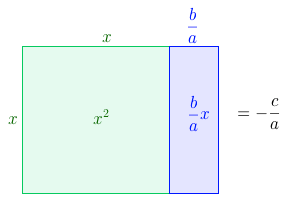
  a perfect square. A visual representation of the equation will be handy. Students should have no problem thinking of a rectangle as visual representation of a product.

Clearly the left hand side is not a square. The way to make one is to cut-off half of the 4x area. But it makes an incomplete square!

Let’s complete it by adding a 2 by 2 square. To keep the balance we add the same amount on the right hand side.

It should be now easy solving for x by extracting the root and using the properties of equality.

I believe that this process will make sense more than using the quadratic formula. Students just memorize the formula without understanding. They also will not remember a piece of it the next day anyway. I’m not saying the quadratic fomula is not completely useful. One application of it is on using the Cosine Rule for ambiguous case.
Should the method of factoring be taught first? I believe it’s best to introduce the students to the method of completing the square first (with the visuals, of course). Once the students get the hang of this procedure, the first thing that they will drop is drawing the rectangle and square and just do it mentally.You can later ask them to investigate the structure of quadratic equations where it is no longer necessary to transfer the constant on the other side. Solving quadratic equation by factoring therefore is a shortcut students should deduce from the procedure of completing the square.
Any new procedure should be linked to previously learned procedure or it should be an improvement of the first. This is my reason why I think the process I described above is a natural sequence to the process of solving linear equation that students already learned. Another reason is that most of the problems students encounter involving quadratic equation is of the form  rather than
  . For example, “Two numbers differ by 4 and their product is 3. What are the two numbers?” The major reason of course is that it will always work for all quadratic equations. Check out the visuals for solving
  .
.
I also developed a geogebra applets Completing the Square Solver and Quadratic Equation Solver that I posted in AgIMat. You can use them to solve quadratic equations and to investigate their roots.